Showing posts with label Carolyne Chronister. Show all posts

Thursday, June 12, 2014

Episode 107: Art for Arts Sake

"Art for arts sake” from French slogan “l’art pour l’art” —expresses a philosophy/concept that the intrinsic value of art, and the only “true” art, is divorced from any didactic, moral, or utilitarian function. In Greek, these works are described as autoteles (aut- + telos, meaning self + goal) or “autotelic—complete in itself.”


Whistler, Nocturne in Black and Gold, 1872-77


“Beauty is a form of Genius--is higher, indeed, than Genius, as it needs no explanation. It is one of the great facts of the world, like sunlight, or springtime, or the reflection in the dark waters of that silver shell we call the moon. It cannot be questioned. It has divine right of sovereignty. It makes princes of those who have it.” —Picture of Dorian Gray, Oscar Wilde


James Abbott McNeill Whistler, The Peacock Room


Edward Burne-Jones, Golden Stairs, 1876-1880, Tate Britain


Rosetti, Lady Lilith, 1868

Soul's Beauty

Body's Beauty


We apologize for the delay in uploading this episode. We hope you enjoyed learning more about "Art for Arts Sake". Next week Lauren will be back with Julia discussing the differences between Florentine and Venetian art. 


Tuesday, April 1, 2014

Episode 100: Our Favorite and Least Favorite Pieces of Art


This is our 100th episode!  It is an exciting milestone for us and we want to thank all of our listeners for sharing this journey with us!  We also want to thank all of our alumni whose work in the podcast over the years we treasure!  We have included messages from some of them in this episode.  We miss you Marie, Kenna, Mary, Megan, Chloe, Zach, and Lauren!

In this episode we each chose an example of our most favorite and our least favorite artists or pieces of art and had a bit of a smackdown!   As we discuss art together, we often find that we have such differing opinions.  Yet none of them are wrong because there is no universally agreed upon example of "best" or "worst" art. What we gain from our debates is a better understanding and greater appreciation for artists and their creations. 


Alisha's Picks
Love:  Winged Victory, or Nike of Samothrace, Unknown Greek artist, c.200-190 BCE
Hate:  Russian Suprematism-- ie:  Red Square by Kazimir Malevich, 1913


Carolyne's Picks
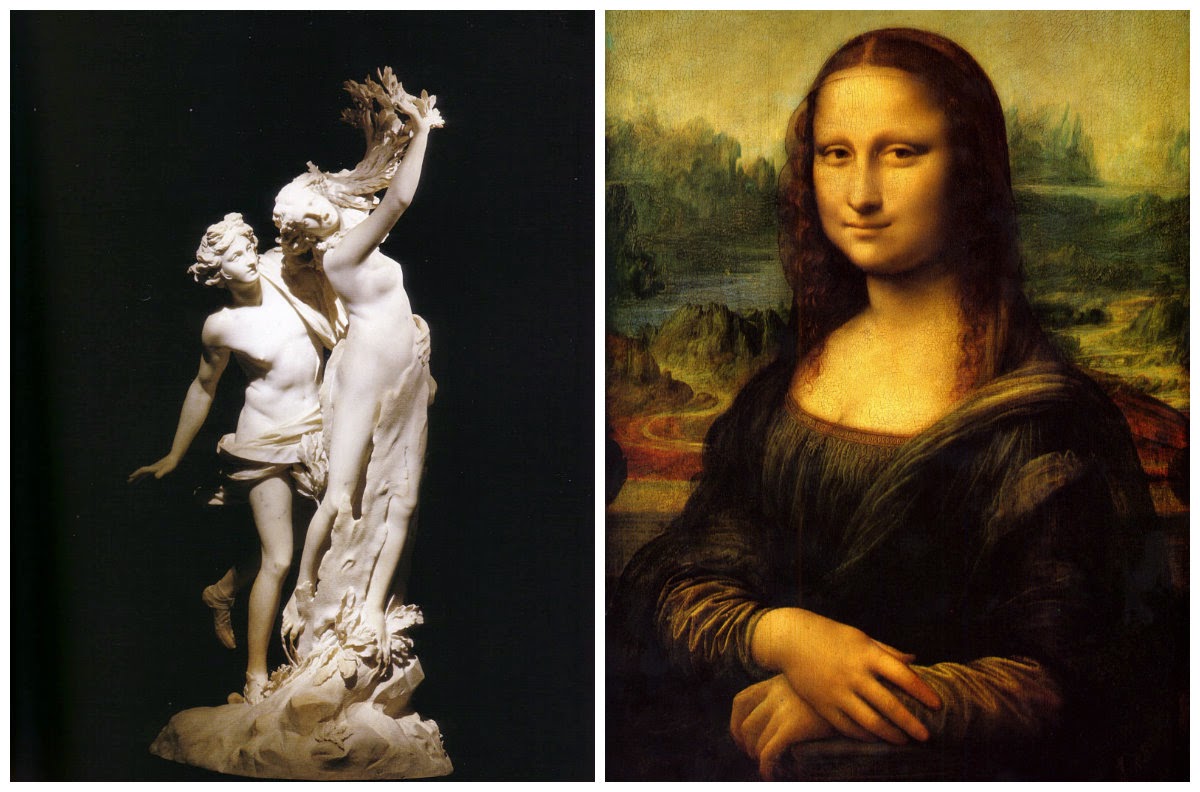
Love:  Apollo & Daphne by Gian Lorenzo Bernini, 1622-1625
Hate:  Mona Lisa (La Gioconda) by Leonardo da Vinci, 1503-1517


Jo's Picks
Love:  The Slave Ship by J.M.W. Turner, 1840
Hate:  Dada-- ie: Fountain by Marcel Duchamp, 1917


Carrie's Picks:
Love:  Antoni Gaudi-- ie: Casa Batllo, 1877
Hate:  Willem de Kooning-- ie: Woman V, 1952-1953


Julia's Picks
Love:  Red Room by Henri Matisse, 1908
Hate:  Street, Dresden by Ernst Ludwig Kirchner, 1908


Thank you for listening today, we hope you enjoyed our 100th Episode! Next week we have a special guest host, Assistant Professor Courtney Davis talking with Julia about the famous French Neoclassical painter David.

Have a great week!

Tuesday, February 25, 2014

Episode 96: Exiled Artists


Probably as far back as written history artists have exiled from their homeland for being subversive, political activists, out spoken or just a little bit to much of a free spirit. Some artists have fled their homeland due to death threats while others, like David, were officially exiled by their government. War is another reason artists have left their homes, like Walter Gropius who left Germany and moved to the US to teach at Harvard University. 

Jacques-Louis David


Jacques-Louis David, Self portrait, 1794

Jacques-Louis David, Oath of the Horatii, 1784


The fact that David made it through the French Revolution with his head still attached to his body is amazing, but he also managed to get his King beheaded, become known as the "Art Dictator of France", become the court painter to Napoleon and still died a natural death in Brussels. Although his heart can still be found in Paris. 

David's headstone at Pere Lachaise Cemetery, Paris


Michelangelo Merisi o Amerighi da Caravaggio

Ottavio Leoni, Chalk portrait of Caravaggio, circa 1621


Caravaggio, David with the Head of Goliath, 1610

When Caravaggio was attacked by his enemies in Naples, his face was so disfigured that he was almost unrecognizable. The Head of Goliath is Caravaggio's self portrait after the incident. You can listen to Episode 15 on Caravaggio on iTunes. Our Caravaggio post is here.  

Walter Gropius


Bauhaus Building

Harvard Graduate Center or “Gropius Complex”. Commissioned in 1948

John F. Kennedy Federal Building, Boston, MA, 1963

Pan Am Building, now the MetLife Building, Manhattan, NY 1958-1962
Gropius House, Lincoln, MA 1937-38
Walter Gropius fled Germany during WWII. He took at job at Harvard's Graduate School of Design and went on to design many of the US's familiar modern structures. 

We hope you enjoyed this episode! Come back next week for our St. Patrick's Day episode with Jo and Alisha! Have a great week!