Showing posts with label Kirchner. Show all posts
Tuesday, April 1, 2014
Episode 100: Our Favorite and Least Favorite Pieces of Art
This is our 100th episode! It is an exciting milestone for us and we want to thank all of our listeners for sharing this journey with us! We also want to thank all of our alumni whose work in the podcast over the years we treasure! We have included messages from some of them in this episode. We miss you Marie, Kenna, Mary, Megan, Chloe, Zach, and Lauren!
In this episode we each chose an example of our most favorite and our least favorite artists or pieces of art and had a bit of a smackdown! As we discuss art together, we often find that we have such differing opinions. Yet none of them are wrong because there is no universally agreed upon example of "best" or "worst" art. What we gain from our debates is a better understanding and greater appreciation for artists and their creations.
Alisha's Picks
Love: Winged Victory, or Nike of Samothrace, Unknown Greek artist, c.200-190 BCE
Hate: Russian Suprematism-- ie: Red Square by Kazimir Malevich, 1913
Carolyne's Picks
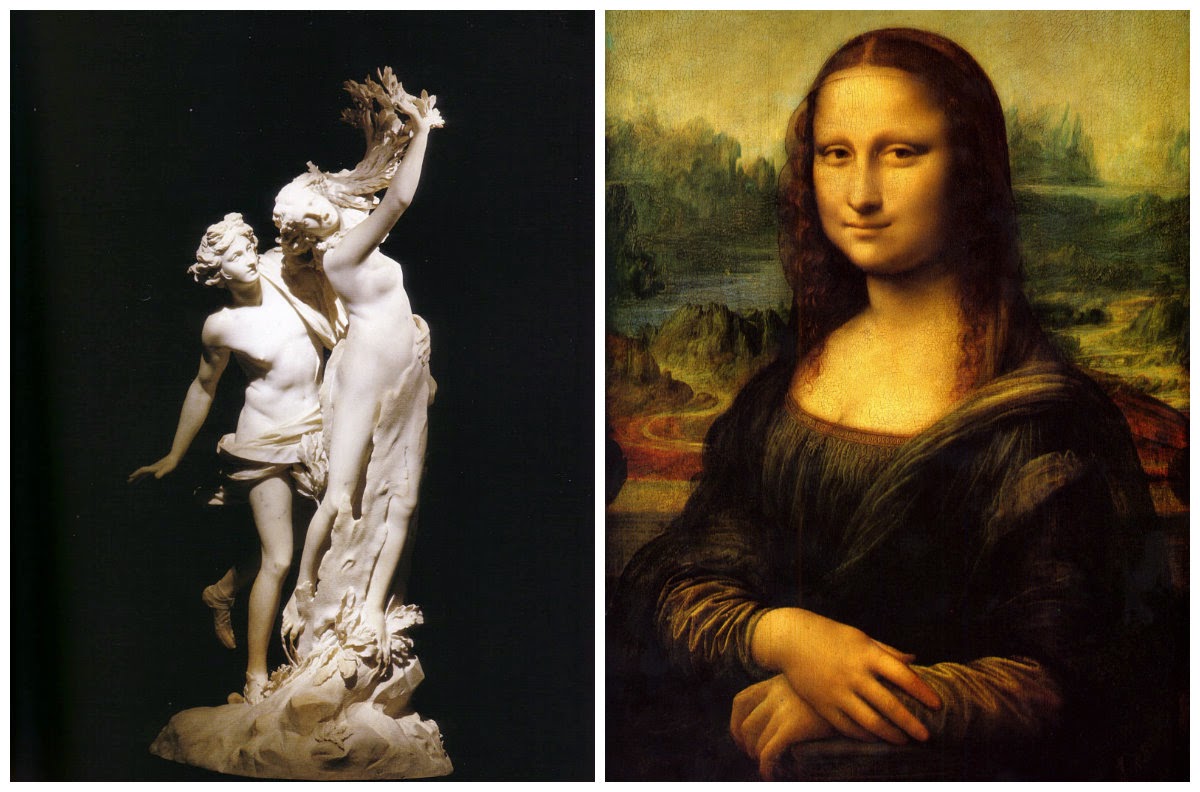
Love: Apollo & Daphne by Gian Lorenzo Bernini, 1622-1625
Hate: Mona Lisa (La Gioconda) by Leonardo da Vinci, 1503-1517
Jo's Picks
Love: The Slave Ship by J.M.W. Turner, 1840
Hate: Dada-- ie: Fountain by Marcel Duchamp, 1917
Carrie's Picks:
Love: Antoni Gaudi-- ie: Casa Batllo, 1877
Hate: Willem de Kooning-- ie: Woman V, 1952-1953
Julia's Picks
Love: Red Room by Henri Matisse, 1908
Hate: Street, Dresden by Ernst Ludwig Kirchner, 1908
Thank you for listening today, we hope you enjoyed our 100th Episode! Next week we have a special guest host, Assistant Professor Courtney Davis talking with Julia about the famous French Neoclassical painter David.
Have a great week!
Labels:
Alisha Wall,
Bernini,
Carolyne Chronister,
Carrie Espinoza,
da Vinci,
de Kooning,
Duchamp,
Gaudi,
Johanna Donaldson,
Julia Allen,
Kirchner,
Malevich,
Matisse,
Turner,
Winged Victory
Wednesday, December 28, 2011
Episode 14: German Expressionism
As Mary and Kenna talk about in the two different, coinciding movements within German Expressionism. Though each group's approach varied, their influences were quite the same.
![]() |
| The Scream by Edvard Munch |
![]() |
| Guitar Player by Picasso |
![]() |
| Where do we come from... by Paul Gauguin |
These are examples of artist both groups of German Expressionists were looking to for their style. Mostly, they took away from the black outlines, the odd coloring, and the expressive use of brushstrokes. From artists like Gauguin (who has a great amount of work inspired by Tahiti and its people), they also found the sense of primitivism inspiring.
![]() |
| Street, Dresden 1908 by Ernst Ludwig Kirchner |
![]() |
| Crucifixion by Emil Nolde |
The German Expressionists often pulled from religious reminders to try and bring a sense of morality back to society as well.
![]() |
| Composition 8 by Wassily Kandinsky |
Kandinsky was a main painter in the Blue Rider movement, the second half of the German Expressionists. They were more likely to paint either what they saw as the solution, or the beauties they wished to preserve in the world. Kandinsky, especially, worked with the idea of "synesthesia"-- a condition where other senses come into play where they might not with others. For example, looking at a Kandinsky can immediately give a sense of music (rhythm, tone, key, etc). Many of his pieces often pulled from music, which is why many are named with musical terms.
![]() |
| Blue Horses by Franz Marc |
![]() |
| Happy Yellow Cow by Marc |
![]() |
| Fate of the Animals by Marc |
If you have topics in art history you're just itching to hear more about, leave us a comment or email us at: uvu.artsandfacts@gmail.com.
Subscribe to:
Posts (Atom)


