
Impressionism was a completely avant garde movement in the latter half of the 19th century. Its different and new ideas sparked a flame in many up and coming artists. Impressionists wanted to capture a fleeting moment. They didn't often spend long periods of time on their works so the end result would be a beautiful array of painterly brush strokes with complimenting color schemes.
 |
| Gustave Caillebotte, Paris Street; Rainy Day, 1877 |
Paris was central to the impressionist movement. We see that in Gustave Caillebotte’s piece "Paris; A Rainy Day". Caillebotte paints figures walking along a boulevard in Paris, they all have quite dark clothes on, and many of them hold umbrellas. Caillebotte’s painted this piece to present Paris as a modern city with great architecture and wide streets to support the flow of traffic.
 |
| Berthe Morisot, Villa at the Seaside, 1874 |
Berthe Morisot’s "Villa at the Seaside" depicts a mother and her child sitting on a porch next to the beautiful French seaside. Most of her paintings focused on domestic subjects. At this time female painters were limited in what they could paint if they wanted to remain respectable. This basically limited their scope to the household.
 |
Renoir, Le Moulin de la Galette, 1876
|
This painting depicts a typical Sunday afternoon in Paris, where the working classes would gather to dance and socialize. As an Impressionist, Renoir was attempting to capture a moment, which is very evident in this painting full of movement. The way he captured the light as it dapples through the trees is simply beautiful.
Post-impressionism
The term ‘post-impressionism’ is used in two ways, some historians use the term to refer to all art created in France during the last 15 years of the 19th century. This includes the works of Impressionists done at this time as well as Symbolist art. Some even include art from outside of France.
Other historians use the term for only three artists, Seurat, Cezanne and Van Gogh (That’s a pretty exclusive club). They remained faithful to the idea of working from nature, like the Impressionists. Other artists allowed imagination to enter into their work.
The ‘term’ post-impressionism was coined by Roger Fry in 1910. Fry argued that it was impossible to define these artists work “by any single term”. He believed that the only thing all post-impressionists had in common was their opinion that Impressionists were too naturalistic.
 |
| Van Gogh, The Night Cafe, 1888 |
Van Gogh had his own meanings for colors. Red and green together equaled misery, which is very telling in "The Night Cafe". If you would like to learn more about Van Gogh we have a whole other episode about him, here.
 |
| Seurat, A Sunday at La Grande Jatte, 1884 |
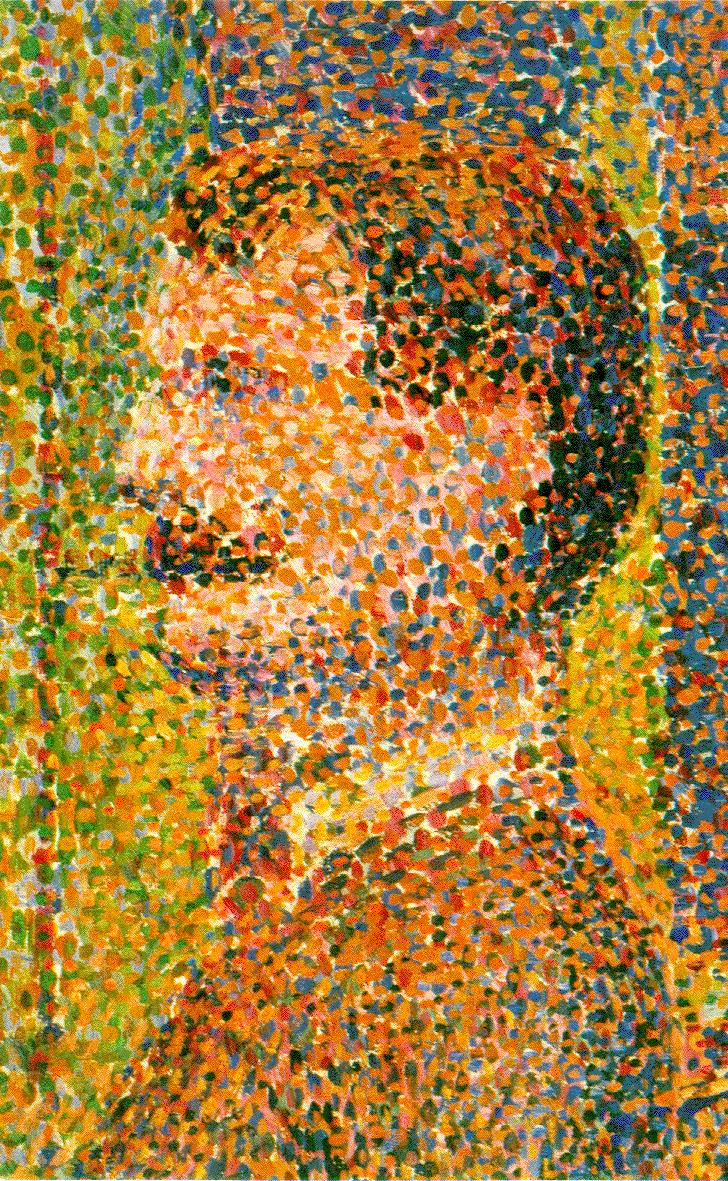 |
| Close up of pointillism |
 |
| Cezanne, Mont Sainte-Victoire, 1895 |
Cezanne sought to depict the nature of reality and our perception of it. This is a view from his home in Aix-en Provence, France where he spent many of his later years painting. He is known for his simplified forms, and use of color and light to give the impression that this is what the land looked like, not what Cezanne painted it to look like.
 |
| Gauguin, Tahitian Women: On the Beach, 1891 |
Gauguin, disillusioned with modern life, left France and his family behind to live in Tahiti. Upon his arrival he discovered that the Western world he longed to leave behind in France had changed the face of Tahiti. He did stay on the island however and painted many images of the native women.
 |
| Toulouse-Lautrec, In the Salon of the Brothel of the Rue des Moulins, 1894 |
Toulouse-Lautrec was interested in painting the relationships he saw between the women who worked in the brothels. He liked using intense colors.
Tune in next week for episode 73 on Famous Art Heists with Chloe and Carrie!


